 RAL Picker
Character of RAL 9005
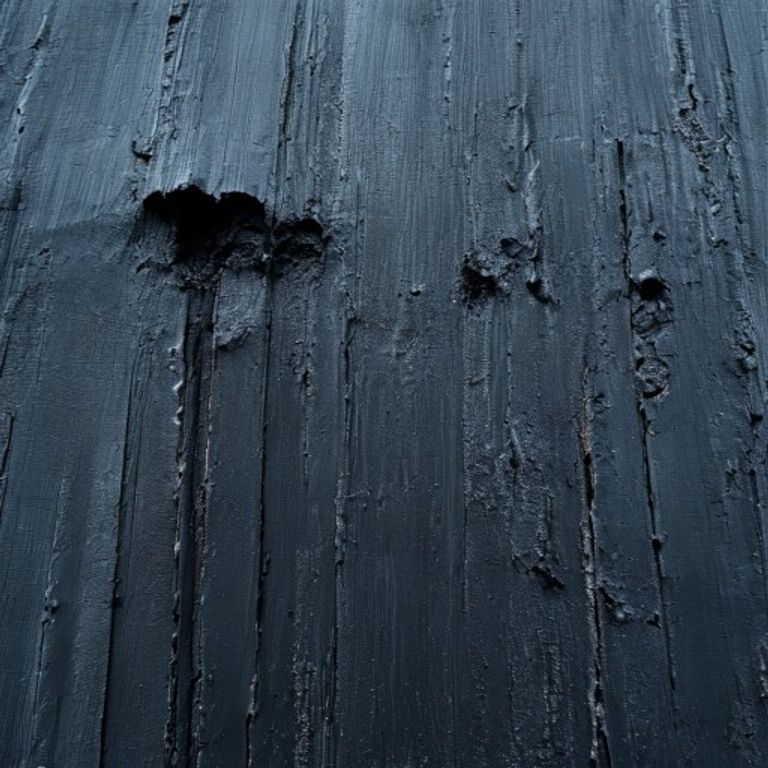
RAL 9005, called Jet black, is not a neutral black. On a white sheet, it registers as a deep, light-absorbing hole. Under direct sunlight, the surface reveals a faint, cool blue-violet undertone—a trace of indigo that disappears entirely in shadow. The finish is matte to semi-matte in standard formulation; gloss versions amplify the blue cast. The visual weight is absolute: this color stops the eye with no reflectivity, no warmth, no brown or sepia bleed. It is the black of a dead pixel, not of charcoal or coal. The mood is authoritarian, silent, and technical. It does not invite touch; it demands distance. In interior lighting (3000K), the blue undertone becomes barely perceptible, and the color reads as a pure, flat void. On a fan deck, it sits at the extreme edge of the RAL Classic range, darker than any gray and blacker than RAL 9011 (Graphite black) by a measurable step in lightness.
Where you see RAL 9005
You encounter RAL 9005 most often in heavy machinery and industrial equipment. It is the standard finish for hydraulic press frames, CNC machine beds, and industrial robot arms—any surface that must resist visual fatigue and communicate brute functionality. In transportation, it appears on railway undercarriages, heavy truck chassis components, and the non-reflective interior panels of aircraft cockpits. Signage uses it for high-contrast lettering on white or yellow backgrounds, particularly in safety instruction plates and emergency exit markers where zero glare is critical. In architecture, it is specified for exterior window frames in high-end minimalist builds, where the black trim must not compete with glass reflections. Consumer electronics with a matte black finish—certain high-end camera bodies, studio monitors, and loudspeaker cabinets—often approximate RAL 9005 for its non-distracting, light-killing property. The color is also common on solar panel frames and mounting rails, where heat absorption is less critical than visual uniformity across large arrays.
Pairs well with
RAL 9005 demands partners that either match its severity or provide sharp contrast without warmth. First, RAL 9010 (Pure white) creates the highest-contrast pairing possible in the RAL Classic system: the white has a slight cream undertone that prevents the black from looking sterile, while the black anchors the white from floating. Second, RAL 3020 (Traffic red) works because the red is a pure, unmixed primary—no orange or maroon dilution—so it stands beside Jet black as a signal, not a decoration. This pair is standard on emergency equipment and warning stripes. Third, RAL 5017 (Traffic blue) offers a deep, slightly greenish blue that echoes the cool undertone in RAL 9005 without matching it. The two colors create a low-chroma, high-contrast industrial palette used in control panels and factory floor markings. Fourth, RAL 7001 (Silver gray) provides a metallic, mid-tone gray that breaks the black's dominance without introducing color. This pairing is common in automotive interior trim and tool housings where the black is the primary body and the gray is the accent.
Common confusion
The most frequent misidentification is with RAL 9011 (Graphite black). On a fan deck, RAL 9011 appears slightly lighter and has a distinct olive-green undertone under daylight, whereas RAL 9005 is visually deeper and shows blue, not green. Hold the two chips edge-to-edge: RAL 9011 will look like a very dark charcoal, while RAL 9005 looks like a hole. In photographs, the difference is often lost because exposure compression flattens both to near-black. Another confusable code is RAL 9004 (Signal black), which is a dark gray, not a true black. RAL 9004 has a visible brownish cast and is noticeably lighter than RAL 9005. The only reliable way to distinguish them is to compare under a 5000K daylight lamp; the blue shift of RAL 9005 versus the brown shift of RAL 9004 becomes obvious.
Picking RAL 9005 from a photo
Use RAL Picker on iOS or Android to sample a surface in a camera view or photo and compare the nearest RAL Classic colors, including RAL 9005. Camera white balance, lighting, shadows and reflections affect the result. Use even, neutral lighting and treat the match as an approximation. Before ordering paint or specifying a finish, confirm the color with a physical RAL swatch.